New JWST Image Shows Spiral Galaxies in Collision
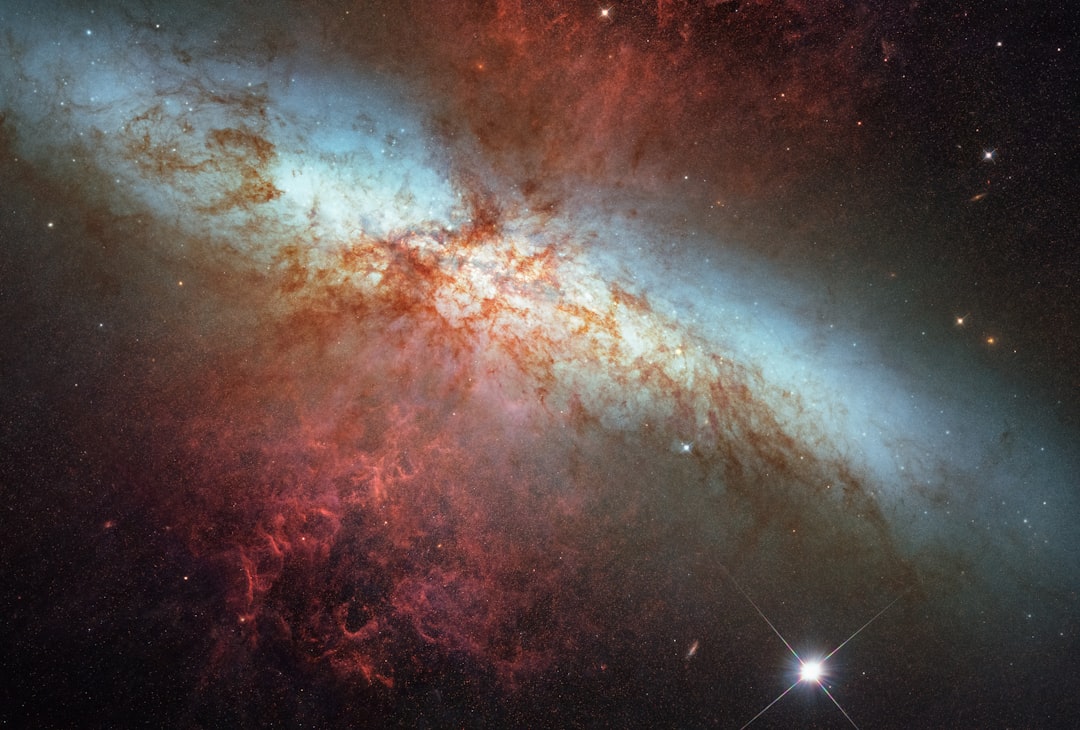
The James Webb Space Telescope captures a detailed image of two spiral galaxies colliding, offering new insights into cosmic events.
What happened
NASA's James Webb Space Telescope (JWST) has captured a remarkable image of colliding spiral galaxies. This image combines mid-infrared observations from JWST with X-ray data from NASA's Chandra X-ray Observatory. The combination of these different wavelengths provides a detailed and layered view of the galaxies.
Key facts
- The image features colliding spiral galaxies.
- Mid-infrared observations from JWST are shown in white, gray, and red.
- X-ray data from Chandra X-ray Observatory is highlighted in blue.
- The combination of these observations reveals a detailed view of the galaxies.
Background & context
The James Webb Space Telescope is a powerful space observatory launched by NASA to study the universe in unprecedented detail. It is designed to observe the universe in the infrared spectrum, allowing it to see through cosmic dust and capture images of distant galaxies, stars, and other celestial phenomena. This capability is crucial because many cosmic objects are obscured by dust and gas, which infrared light can penetrate more effectively than visible light. The Chandra X-ray Observatory, another NASA mission, observes X-rays from high-energy regions of the universe, such as the remnants of exploded stars, black holes, and supernovae. X-rays are emitted by some of the most energetic and extreme environments in space, providing insights into the physical processes occurring in these regions. By combining data from both JWST and Chandra, scientists can gain a more comprehensive understanding of the dynamics and interactions within and between galaxies.
Why it matters (for US readers)
The collaboration between JWST and Chandra X-ray Observatory in capturing these images demonstrates the capabilities of modern space telescopes in enhancing our understanding of the universe. Such observations can provide insights into the processes involved in galaxy formation and evolution, which are fundamental to our understanding of the cosmos. For US readers, this represents a significant achievement in space exploration and scientific research, showcasing the technological advancements and contributions of NASA. The ability to observe and analyze colliding galaxies is crucial for understanding the life cycle of galaxies, including our own Milky Way. These cosmic events can trigger star formation and alter the structure of galaxies, influencing their future development. The data gathered from these observations can help scientists develop models to predict the behavior of galaxies over time, contributing to our broader understanding of the universe's history and future.
Stakeholders & viewpoints
- NASA: As the agency behind both JWST and Chandra, NASA continues to lead in space exploration and research. The successful deployment and operation of these telescopes highlight NASA's commitment to advancing scientific knowledge and technology.
- Astronomers and Scientists: These images provide valuable data for researchers studying galaxy formation and cosmic phenomena. The detailed observations allow scientists to test theories about galaxy interactions and the role of dark matter and dark energy in the universe.
- General Public: The stunning images captured by these telescopes inspire interest and curiosity about space and science. Public engagement with such discoveries can foster a greater appreciation for science and technology, encouraging educational pursuits in these fields.
Timeline & what to watch next
- Ongoing Observations: JWST and Chandra will continue to observe and capture data from various cosmic phenomena. Their ongoing missions are expected to yield a wealth of information about the universe's most intriguing and mysterious aspects.
- Future Discoveries: As more data is collected, new insights into the universe are expected. Scientists anticipate that continued observations will lead to breakthroughs in understanding the fundamental forces and components of the cosmos.
- Technological Developments: Continued advancements in space telescope technology may lead to even more detailed observations. Future missions may build upon the successes of JWST and Chandra, incorporating new technologies to explore the universe in even greater detail.
Sources
Up Next
